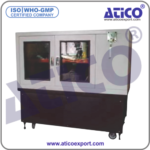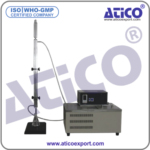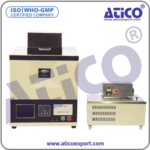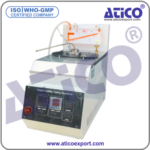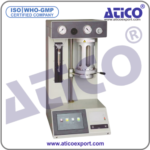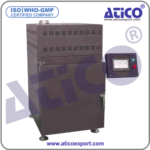
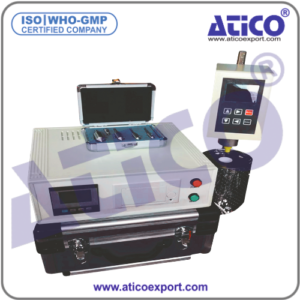
The motor drives the rotor at a constant speed, adjusting the speed as required. When the rotor is in motion within a specific liquid, the liquid will generate a viscous torque that acts on the rotor. The viscosity of the liquid in question has a direct impact on the viscous torque generated. In general, the greater the viscosity, the greater the torque. Conversely, the smaller the viscosity, the smaller the torque. The viscous torque acting on the rotor is detected by the sensor, after which the viscosity of the measured liquid can be obtained through computer processing.This instrument is equipped with four rotors (21, 27, 28, 29) and four speeds (5, 10, 20, 50 r/min), allowing for the measurement of viscosity values of various liquids within the specified measurement range through the use of different combinations.
Technical Specification:-
Measurement Range : 100 mPa•s to 2×10⁵ mPa•s (Can be extended to 4×10⁵ mPa.s with optional No. 30 spindle)
Rotor : Nos. 21, 27, 28, and 29 (4 total) (No. 30 spindle is optional)
Rotor Speed : 5, 10, 20, 50 r/min
Measurement Error : ±1% (F.S); if No. 30 spindle is selected, it will be ±3% (F.S)
Temperature Control Range : 45°C to 200°C
Temperature Control Accuracy : ±0.1°C
Cylinder Volume : 20 ml
Print Output : Needle printer
Communication Interface with PC : RS 232
Power Supply : 220 (±10%) VAC, 50 Hz, Single Phase
Working Environment : Temp. Ranging : from 5 °C to 35 °C
Relative Humidity : ≤ 80%