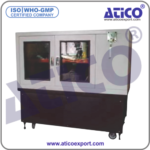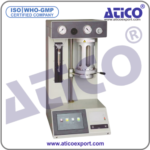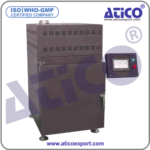
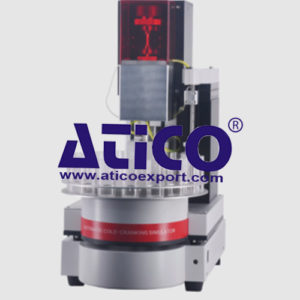
Product structure:
Automated Cold-Cranking Simulator consists of a patented thermoelectrically-cooled rotor/stator with vacuum system and injection pump, 16 position sample table, a temperature verification kit, an integrated controller, a waste receiver, a recirculating cooler, proprietary software.
Features:
- The Cold Cranking Simulator can automatically detect speed and control current, reduce human error;
- Driven by imported motor, high precision;
- Semiconductor refrigeration system can quickly test any temperature;
- The result is automatically calculated after calibration by standard oil;
- Computer control, Windows operating system, XP, Win7, can be connected to a printer to print results;
- Improved rotor, low torque test state, high repeatability;
- Automatically generate calibration curve and directly display the test viscosity result;
- All test processes are controlled automatically without manual operation, and the test will automatically stop and increase temperature after the test;
- The CCS Cold Cranking Simulator can automatically recommends the refrigeration temperature; 10. Rotary encoder detects speed;
- Viscosity measurement range: 1500~15000CP;
- The results of 20 standard oils can be edited;
- This Cold Cranking Simulator is equipped with dedicated low-temperature refrigeration cycle equipment.
- The Apparent viscosity tester can automatically calculate the standard oil calibration deviation to help users check the accuracy of the calibration data;
Specifications:
- Applicable standard: GB/T6538, ASTM D2602,ASTM D5293
- Refrigeration method:Semi-conductor
- Circulation method: multifunctional plastic steel pump
- controlling method: Digital PID temperature controller
- Detection mode: automatic injection, automatic cleaning, automatic test
- controlling range: -5ºC -10ºC -15ºC -20ºC -25ºC -30ºC -35ºC (optional -40ºC)
- Temperature controlling accuracy: ±0.02ºC
- Power supply :AC220 V 50Hz
- Working units: 16
- Dimension :780*560*960mm
- Net weight :40KG
Applications and Uses:
The CCS Viscosity Standard finds implementation in diverse industries where accurate viscosity measurements are of utmost importance, such as:
- The automotive industry, where the development and testing of lubricants require adherence to specified viscosity for optimal engine performance.
- Lubricant manufacturers depend on the CCS Viscosity Standard to verify and maintain consistency and quality in their product range.
- In mechanical engineering, cold-cranking simulators, extensively used in testing systems, require calibration and performance verification using the CCS Viscosity Standard.